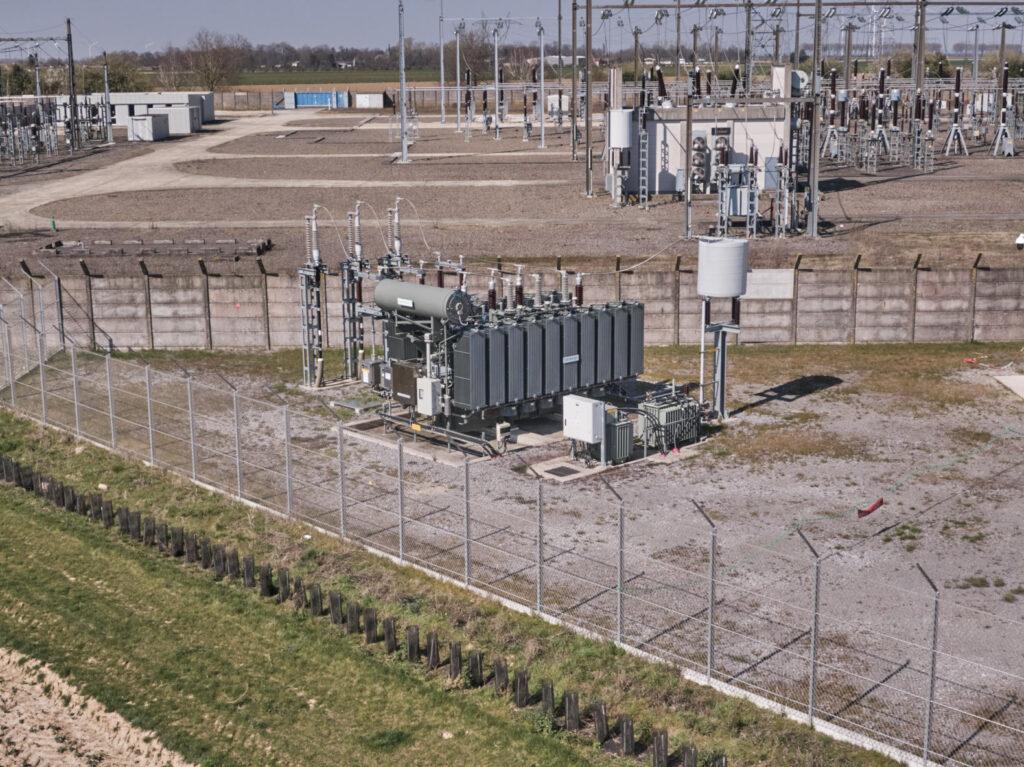
Given the increasingly limited connection capacity on the public distribution network (primarily managed by ENEDIS), more and more generation assets and battery energy storage systems (BESS) are now being connected to the public transmission network (managed by RTE). These are areas fraught with challenges!
From 2021 onwards, to help its clients tackle these new challenges, VALEMO has organised itself around three key areas to meet this new need:
- The first: a control centre – operated 24 hours a day, 7 days a week, 365 days a year by a team of 7 technicians – equipped with RTE systems (Secure Telephony System and Alert and Backup System),
As a reminder, the designation of a 24-hour, 7-day-a-week control centre is a necessary prerequisite for energising the high-voltage substation,
- The second: the creation of an operations department dedicated to high-voltage substations, comprising three engineers specialising in electrical engineering,
- The third: the development of a theoretical and practical training programme (including practical exercises at a high-voltage substation) for our maintenance technicians based in our branches across mainland France, who are the personnel closest to the sites and the risks inherent in this activity.
When commissioning a new high-voltage substation, or when resuming operations at an existing high-voltage substation, there are numerous challenges for both the project owner and the future operator, and these are crucial to the smooth running of the site for years to come.
When commissioning a new high-voltage substation, the key issues are:
- To identify actual requirements in order to negotiate the best possible EPC and maintenance contracts:
The prices of contracts for the supply and maintenance of a high-voltage substation can vary considerably depending on the services and options selected.
It is therefore essential for the project owner to clearly identify the requirements set by RTE, as well as the equipment, services or options that offer genuine benefits or added value for the site and for its decades of operation.
Having an experienced operator on board throughout the process of setting up the high-voltage substation monitoring system helps to keep costs under control and ensures that the final system will deliver real added value on a day-to-day basis for the operator and, by extension, for all the generation assets connected to the substation. In short, it’s a genuine win-win situation.
- To ensure that the high-voltage substation is commissioned without affecting generation assets:
When commissioning a production asset, it goes without saying that all parties involved (both suppliers and customers) want the provisional schedule to be adhered to in order to ensure a swift commissioning process and avoid delaying the asset’s production. This is a critical moment when any delay can quickly prove costly.
Support from an experienced operator with access to STS/SAS tools facilitates communication with the various RTE departments (dispatching, GMR, GMP, etc.) to ensure a secure and optimised commissioning process. Furthermore, as VALEMO’s core business is the generation of renewable energy, our understanding of customers’ needs – combined with our generator perspective – enables us to anticipate and resolve any issues that arise during commissioning.
- To ensure that the high-voltage substation remains compliant for years to come:
Some people believe that the HTB substation is merely a electricity connection to the public transmission grid, but its availability and reliability will have a decisive impact on the output of the generation assets connected downstream.
A number of pieces of equipment have been specifically manufactured for your HV substation (transformers, high-voltage equipment, control and monitoring systems, etc.); therefore, any failure or premature ageing of these would prevent your assets from generating electricity for several weeks or even several months.
It is therefore very important to carry out a thorough follow-up even before the system is energised (participation in factory and on-site acceptance tests of the control and command system, testing of electrical protection systems, inspection visits at the end of construction and before the transformer is magnetised, verification of the DOE, etc.)
When the high-voltage substation resumes operation, the key issues are:
- To analyse the condition of an ageing asset in order to identify requirements
A comprehensive on-site audit of the high-voltage substation, together with an analysis of past reports, provides an understanding of which maintenance tasks have been carried out or overlooked. This comprehensive assessment enables the development of a maintenance roadmap to stabilise or improve the operational condition of the high-voltage substation.
- To identify the system’s weaknesses in order to plan for its replacement
As the high-voltage substation was built several years ago by a supplier (who may no longer be in business), by an operator with a different approach, and by a maintenance provider who does not necessarily share the same priorities, it is essential to identify any potential weaknesses at the site as soon as possible, whether these relate to equipment or cyber risk. Understanding these weaknesses will enable the analysis of alternatives and the planning of potential equipment replacement in line with a budget schedule defined in advance, thereby minimising the impact on production resources.
- To ensure that the necessary resources for its operation are in place
The previous parties involved (operator or maintenance provider) will wish to hand over responsibility as soon as possible, and it will not be easy (or cheap) to re-engage them at a later date. It is therefore necessary to secure the elements required for the smooth operation of the high-voltage substation (programmes, configurations, administrator credentials, etc.) in order to be as self-sufficient as possible for years to come.
VALEMO references:
|
Since 2021 |
Connection voltage |
Production |
Client |
|
High-voltage substation 1 |
90 KV |
Wind power |
Client 1 |
|
High-voltage substation 2 |
63 kV |
Wind power |
Client 2 |
|
High-voltage substation 3 |
63 kV |
Wind power + BESS |
VALOREM |
|
High-voltage substation 4 |
63 kV |
Wind power + BESS |
VALOREM |
|
High-voltage substation 5 |
225 kV |
BESS |
Client 3 |
|
Since Q3 2026 |
Connection voltage |
Production |
Client |
|
High-voltage substation 6 |
225 kV |
Wind power |
Client 4 |
|
High-voltage substation 7 |
90 KV |
Wind power + Solar power + BESS |
Client 5 |
|
High-voltage substation 8 |
225 kV |
BESS |
Client 6 |
|
High-voltage substation 9 |
90 kV |
Wind power + BESS |
VALOREM |
|
High-voltage substation 10 |
225 kV |
BESS |
Client 3 |
|
High-voltage substation 11 |
63 kV |
Wind power |
Client 6 |
|
To be signed |
Connection voltage |
Production |
Client |
|
High-voltage substation 12 |
225 kV |
BESS |
Client 7 |
|
High-voltage substation 13 |
225 kV |
BESS |
Client 6 |
|
High-voltage substation 14 |
225 kV |
Wind power + BESS |
Client 8 |